What is an IT contingency plan?
What is an IT contingency plan?
An IT contingency plan is a practical plan for how a company handles critical IT incidents. It outlines roles, responsibilities, points of contact, priority systems, communication, backup, recovery, and documentation.
The goal is to reduce downtime, minimize damage, and ensure that the company can make quick and well-informed decisions under pressure.
An IT contingency plan should not be a lengthy document that only a few people are familiar with. It should be concise, practical, and tailored to the company’s actual operations. This is especially important if the company relies on a few key systems, external vendors, or cloud platforms.
Why an IT Contingency Plan Is Important for Businesses
Cyber incidents rarely occur at a time when an organization has ample time to coordinate a response. A phishing email can lead to compromised login credentials. Ransomware can render files and systems inaccessible. A vendor failure can affect access to critical platforms. A cloud infrastructure outage can affect employees, customers, and operations simultaneously.
Without a clear IT contingency plan, the response often depends on individuals and ad hoc decisions. This can prolong downtime, create uncertainty about responsibility, and make it more difficult to document what happened.
With a well-developed contingency plan, the company can more quickly:
• assess the scope of the incident
• activate the right people
• prioritize critical systems
• communicate internally and externally
• limit damage and downtime
• document decisions and actions
• restore operations in the correct order
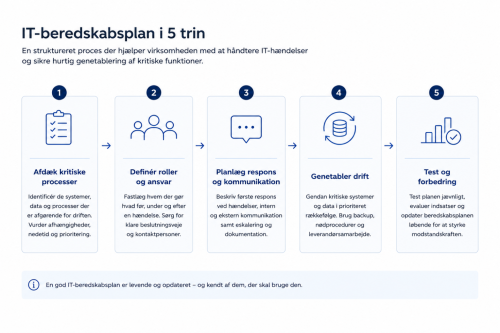
IT Contingency Plan Template: What Should It Include?
A practical IT contingency plan template should, at a minimum, include the elements the company needs during a specific incident. The template should not be more comprehensive than necessary, but it must provide sufficient clarity to enable management, IT, vendors, and key personnel to act quickly.
An IT contingency planshould include:
- Purpose and Scope
- critical systems, data, and processes
- roles and responsibilities
- Contact list for management, IT, suppliers, and consultants
- first-response procedure
- Escalation and Decision-Making Authority
- internal and external communication plan
- Backup and Recovery Procedure
- Alternative Workflows in the Event of a System Failure
- Documentation of events and decisions
- testing, evaluation, and updating
The template should be tailored to the company’s size, industry, IT environment, and risk profile. A smaller company often needs a simple, operational plan, while a larger organization typically requires more detailed roles, communication channels, and technical recovery procedures.
The IT contingency plan must be based on operations and risk
A robust IT contingency plan does not start with a generic template. It starts with the company’s operations. The key question is: Which systems, data, and processes are most critical to delivering core services?
For some companies, it’s the financial system, email, and customer data. For others, it’s production management, access control, record-keeping systems, booking systems, logistics, or integrations with suppliers. If the plan doesn’t take these differences into account, it quickly becomes too general.
The company should therefore consider:
- which systems are business-critical
- how long the systems may be unavailable
- which data should be restored first
- which suppliers are needed for restoration
- which manual emergency procedures can be used on a temporary basis
- who has decision-making authority during an incident
This makes the contingency plan more practical because it links technical responses to specific operational consequences.
What should a contingency plan include?
A contingency plan should be concise enough to be used under pressure and detailed enough to provide clear guidance. It should not describe every conceivable scenario in depth, but it should provide the organization with a common basis for action.
- Purpose and Scope
The plan should describe the types of incidents it covers. These may include cyberattacks, ransomware, system failures, data loss, supplier failures, compromised user accounts, or unavailable cloud services.
It should also clarify whether the plan applies to the entire organization, specific departments, specific systems, or particularly critical processes.
- Critical Systems and Prioritization
The company should have a prioritized overview of the systems and data that are most critical to operations and service delivery. This makes it easier to make decisions when multiple systems are affected at the same time.
For each critical system, the plan should, at a minimum, describe:
- how the system works
- system owner
- Technical Manager
- dependencies on suppliers or other systems
- acceptable downtime
- Backup and Recovery Requirements
- Alternative Workflow in the Event of a System Failure
- Roles and Responsibilities
An incident requires a clear division of roles. If responsibility has to be determined only after the incident has begun, valuable time is lost.
The plan should define responsibilities for:
- Decisions and Priorities
- Technical Analysis and Remediation
- contact with suppliers
- internal communication
- external communications
- legal and regulatory assessments
- documentation and post-evaluation
In smaller companies, one person may hold multiple roles. The most important thing is that everyone is aware of where responsibility lies.
- Initial Response to Incidents
The first few hours are often critical. The plan should therefore include a simple procedure for the initial response.
This may include:
- how the incident is detected and reported
- who to contact first
- how the incident is classified
- When management gets involved
- when to contact suppliers or external consultants
- how evidence, logs, and decisions are documented
- how to minimize further damage
A good initial response isn't just about speed. It's about taking the right actions so that the company doesn't make the situation worse or lose important documentation.
- Internal and External Communication
Communication is often one of the most underestimated aspects of an IT contingency plan. During an incident, employees, customers, suppliers, and management need clear information.
The plan should describe:
- who is authorized to communicate about the incident
- which channels to use if email or Teams aren't working
- how employees are trained
- how customers or suppliers are informed
- how communication is coordinated with legal requirements and management decisions
Communication must be precise and factual. This reduces uncertainty and helps the organization focus on the most important actions.
- Backup, Recovery, and Restoration
Backup is a key part of IT disaster recovery, but backup alone is not enough. The company needs to know whether backups can actually be restored, how long it takes, and which systems need to be restored first.
The plan should therefore link backup procedures to specific operational requirements. This includes, among other things, recovery time, data loss, prioritization, and testing.
A company should, at a minimum, be able to answer the following:
- the latest date the backup was tested
- which systems can be restored first
- how long recovery takes
- where the backup is stored
- Who can enable recovery
- which manual processes can be used in the meantime
IT Contingency Plan, NIS2, and ISO 27001
For some companies, the IT contingency plan is also part of their compliance and documentation efforts.
NIS2 is an EU directive that sets requirements for cybersecurity risk management for covered entities. It covers, among other things, incident response, business continuity, crisis management, supply chain security, and management responsibility. Read more here: NIS2 Consulting and Compliance | Nesp.ONE & https://digital-strategy.ec.europa.eu/en/policies/nis2-directive
ISO 27001 is an international standard for information security management systems. The standard can be used as a framework for a structured approach to risk assessment, security measures, incident management, and continuous improvement. Learn more here: ISO 27001 Consulting and Certification | Nesp.ONE & https://www.iso.org/standard/27001
ENISA recommends that organizations take a practical approach to security measures, emergency preparedness, and cyber hygiene, particularly for SMEs, where resources and specialized expertise are often limited. Read ENISA’s guide for SMEs: https://www.enisa.europa.eu/publications/cybersecurity-guide-for-smes
Common Errors in IT Contingency Plans
Many companies have a contingency plan, but still find that it doesn't work well enough when they need to use it. This is often because the plan is too theoretical or hasn't been updated.
Common errors include:
- The plan is too long and difficult to use under pressure
- Contact information and supplier details are out of date
- Critical systems are not a priority
- The backup has not been tested
- Roles and decision-making authority are unclear
- The plan has not been rehearsed with the relevant individuals
- Communication channels in the event of a system failure have not been clarified
- Lessons learned from tests and incidents are not incorporated
An IT contingency plan only adds value when it can be put into practice. Therefore, the plan should be tested, updated, and reviewed on an ongoing basis.
How to Test and Maintain Your Emergency Plan
An IT contingency plan is not complete once it has been written. It must be maintained, tested, and adapted as the company changes its systems, vendors, organizational structure, or risk profile.
This can be done by:
- annual review of the plan
- Backup and Restore Test
- Exercises involving management, IT, and key personnel
- Updating contact lists
- Evaluation following incidents and tests
- link to risk assessment and safety work
In this way, IT preparedness becomes a practical part of the company's overall information security.
How to Get Started with an IT Contingency Plan
A company does not need to start by developing complex contingency plans. The most important thing is to gain a realistic overview and establish a plan that can be used for the most likely and most critical incidents.
Start with these questions:
- Which systems and data are most critical to our operations?
- Which events will affect us the most?
- Who makes decisions during an incident?
- Who contacts suppliers and external consultants?
- How do we communicate if our usual channels aren't working?
- How quickly can we restore critical systems?
- When was the last time we tested our backup and disaster recovery procedures?
- Can we document our decisions and actions during an incident?
Once the answers are in place, the company can draw up a plan that is specific, concise, and actionable.
Get help with IT contingency plans
At Nesp.ONE, we help companies develop, improve, and test IT contingency plans. We base our work on the company’s operations, risks, systems, and documentation requirements, ensuring that the plan is practical and can support compliance with NIS2, ISO 27001, and customer and supplier requirements.
If you need to have your current IT contingency plan assessed or a specific IT contingency plan developed, please contact Nesp.ONE for a no-obligation discussion about the next steps.
Ready to strengthen your cybersecurity?
Eller har I spørgsmål som ikke blev besvaret. Bestil en 15 min gratis gennemgang med en cybersikkerhedsekspert.